
What Is Inflammation? A Simplified Guide to Acute vs. Chronic Inflammation

Inflammation is your immune system's built-in response to injury, infection, or irritation. In short bursts (acute), it's a sign your body is healing correctly. When it lingers for months or years (chronic), it's linked to conditions like autoimmune disease, heart disease, and metabolic issues and it's often silent until symptoms like fatigue, joint pain, or skin flare-ups show up.1 Below, we break down what inflammation is, what it isn't, how to spot it, how it's tested, and what you can do about it.
What Is Inflammation?
Inflammation is your immune system doing its job. When your body senses a threat like a cut, a virus, an allergen, or any kind of foreign invader, it releases its first responders. These are cells, like cytokines, that start the inflammatory response.1,2 This inflammatory response increases blood flow to the area, brings in white blood cells, and triggers the swelling, redness, or warmth you feel when you sprain an ankle or catch a cold. This inflammation is necessary and helps us to protect ourselves.
There are two broad categories:1,2
- Acute inflammation: A short-term reaction lasting from hours to a few weeks. It responds to something specific, like a cut, sore throat, or workout. It resolves once the threat is gone.
- Chronic inflammation: A low-grade, long-term immune response that can persist for months or years, often without an obvious trigger. This is the type most linked to long-term health risks.
What makes chronic inflammation so tricky to nail down is that it’s often silent and hard to pint down. Brain fog, persistent fatigue and low mood are symptoms that could be caused by a multitude of conditions.
What Inflammation Is Not:
Because "inflammation" has become a wellness buzzword, it helps to clear up a few misconceptions:
- It's not always visible. You don't need swelling or redness to have inflammation as chronic, low-grade inflammation is often internal and may be symptomless for years.3
- It's not always bad. Acute inflammation is a healthy, necessary response. Without it, wounds wouldn't heal and infections wouldn't clear. We want our immune system to investigate if there’s fire when it senses smoke.
- It's not one specific disease. Inflammation is a process, not a diagnosis. It's a mechanism that shows up across many different conditions, from gastrointestinal disorders to autoimmune disease.1
- It's not something a single food or supplement "cures." Diet matters, but chronic inflammation is usually multi-factorial and is often driven by genetics, stress, sleep, hormones, gut health, and environment together. Anyone promising you that their supplement will cure your inflammation is trying to sell you something.
What Are the Symptoms of Chronic Inflammation?
Because chronic inflammation is systemic rather than localized, symptoms are often vague and easy to dismiss. Common signs include:1-4
- Persistent fatigue, even after adequate sleep
- Joint pain or stiffness, especially in the morning
- Digestive issues (diarrhea, constipation, and acid reflux)
- Skin flare-ups like acne, eczema, or unexplained rashes
- Frequent infections
- Unexplained weight changes
- Low mood, increased anxiety or other mood disorders
As you can see, none of these symptoms are exclusive to inflammation and if you ask your friendly neighbourhood AI doctor, you could get back answers such as Lupus, Crohn’s disease, and HIV. Trust us, we tried. It’s important to think of inflammation as a road sign rather than a destination.
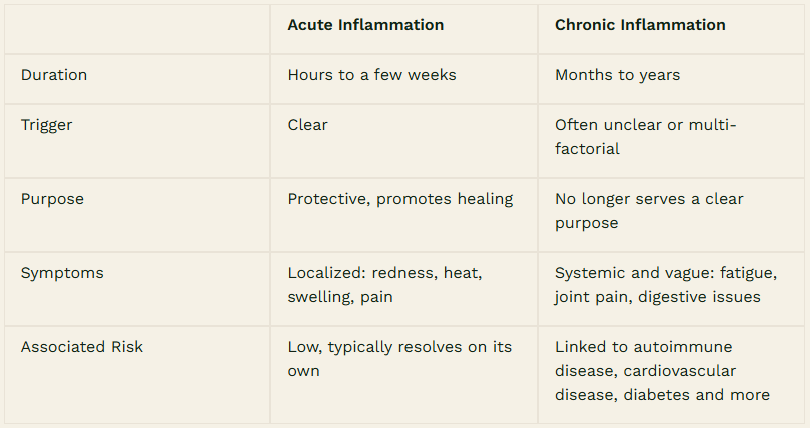
The key distinction here is that acute inflammation turns off once the threat is handled. Chronic inflammation doesn't get the "off" signal, and the immune system stays mildly activated long after it's needed, which can be damaging over time. Think of a building on fire. The smoke alarm goes off, and this signals the fire department to come and target the flames. With chronic inflammation, there’s no fire but every smoke alarm on the block is going off and the fire department is sending trucks that are spraying wildly in every direction.
How Can You Test for Inflammation?
There's no single test that says, "you have inflammation," but a few blood markers are commonly used to screen for it:
- CRP (C-reactive protein): Produced by the liver in response to inflammation. A standard CRP test is often used when a provider suspects an infection or autoimmune flare, since levels rise quickly with acute inflammation.4
- hs-CRP (high-sensitivity CRP): A more sensitive version of the same test, used specifically to assess low-grade, long-term inflammation and cardiovascular risk in otherwise healthy people. Levels under roughly 3 mg/L are generally considered low risk, while higher levels can point to ongoing, low-grade inflammation.4
- ESR (erythrocyte sedimentation rate): Measures how quickly red blood cells settle in a test tube. Inflammation causes them to settle faster. ESR tends to rise and fall more slowly than CRP, so it's often used alongside it.5
CRP and ESR are non-specific, meaning that they tell you that inflammation is present, not where it's coming from or why. Values can also be affected by factors like obesity, pregnancy, smoking, or hormonal shifts, which is why results should always be interpreted alongside your symptoms and full history with a healthcare provider, not read in isolation.
Interestingly, inflammatory and autoimmune conditions also show a notable sex gap. Research suggests that most there is a higher prevalence of autoimmune conditions among women than men.6,7
How Can You Lower Chronic Inflammation?
There's no single fix, but a few evidence-backed levers consistently make a difference:
- Prioritize sleep consistency. Poor or irregular sleep is one of the most reliable drivers of elevated inflammatory markers. The research even suggests that the association between poor sleep and inflammation may be stronger in women.8 Prioritize your nightly routine and aim for a consistent wake time, even on weekends.
- Move regularly, not necessarily intensely. Studies on structured aerobic exercise programs have shown measurable reductions in hs-CRP levels over several weeks, even without dramatic weight loss.4,9
- Address gut and metabolic health. Diets higher in fiber, omega-3s, and minimally processed foods are associated with lower inflammatory markers than diets high in refined sugar and ultra-processed foods.4,10
- Manage chronic stress. Ongoing psychological stress keeps inflammatory signaling activated. Building in self care (not just pushing through) is protective, not indulgent.11
How Can July Health Help with Inflammation?
Chronic inflammation is hard to manage because it's invisible, multi-factorial, and easy to dismiss, until it isn't. July Health was built to help you figure out what your symptoms mean and how you can start working on improving them right away.
Our nurse practitioners can help you order the testing you need to get to the bottom of your symptoms right away. Our registered dietitians can help you figure out a meal plan and an eating pattern that minimizes inflammation and helps improve your energy. Our therapists can support you through the brain fog and low mood that’s often associated with inflammatory states.
Book a session with one of our practitioners to learn more.
Stay tuned for the second post in this series where we discuss the dietary changes you can make to improve inflammation.
This article is for informational purposes only and isn't a substitute for individualized medical advice. Talk to your doctor before starting or stopping any medication.
References:
1. Chavda VP, Feehan J, Apostolopoulos V. Inflammation: The Cause of All Diseases. Cells. 2024 Nov 18;13(22):1906. doi: 10.3390/cells13221906. PMID: 39594654; PMCID: PMC11592557.
2. Chen L, Deng H, Cui H, Fang J, Zuo Z, Deng J, Li Y, Wang X, Zhao L. Inflammatory responses and inflammation-associated diseases in organs. Oncotarget. 2017 Dec 14;9(6):7204-7218. doi: 10.18632/oncotarget.23208. PMID: 29467962; PMCID: PMC5805548.
3. Pawar S. Low-grade chronic inflammation in young adults: An underrecognized epidicemic. Explore (NY). 2026 May-Jun;22(3):103377. doi: 10.1016/j.explore.2026.103377. Epub 2026 Mar 5. PMID: 41818927.
4. Pahwa R, Goyal A, Jialal I. Chronic Inflammation. [Updated 2023 Aug 7]. In: StatPearls [Internet]. Treasure Island (FL): StatPearls Publishing; 2026 Jan-. Available from: https://www.ncbi.nlm.nih.gov/books/NBK493173/
5. Tishkowski K, Zubair M. Erythrocyte Sedimentation Rate. 2025 Jul 7. In: StatPearls [Internet]. Treasure Island (FL): StatPearls Publishing; 2026 Jan–. PMID: 32491417.
6. Rubtsova K, Marrack P, Rubtsov AV. Sexual dimorphism in autoimmunity. J Clin Invest. 2015 Jun;125(6):2187-93. doi: 10.1172/JCI78082. Epub 2015 Apr 27. PMID: 25915581; PMCID: PMC4497744.
7. Gal-Oz ST, Shay T. Genetics of Sex Differences in Immunity. Curr Top Microbiol Immunol. 2023;441:1-19. doi: 10.1007/978-3-031-35139-6_1. PMID: 37695423.
8. Ballesio A, Fiori V, Lombardo C. Effects of Experimental Sleep Deprivation on Peripheral Inflammation: An Updated Meta-Analysis of Human Studies. J Sleep Res. 2026 Feb;35(1):e70099. doi: 10.1111/jsr.70099. Epub 2025 Jun 5. PMID: 40474574; PMCID: PMC12856123.
9. Hammonds TL, Gathright EC, Goldstein CM, Penn MS, Hughes JW. Effects of exercise on c-reactive protein in healthy patients and in patients with heart disease: A meta-analysis. Heart Lung. 2016 May-Jun;45(3):273-82. doi: 10.1016/j.hrtlng.2016.01.009. Epub 2016 Feb 23. PMID: 26916454; PMCID: PMC5873310.
10. Yu X, Pu H, Voss M. Overview of anti-inflammatory diets and their promising effects on non-communicable diseases. Br J Nutr. 2024 Oct 14;132(7):898-918. doi: 10.1017/S0007114524001405. Epub 2024 Oct 16. PMID: 39411832; PMCID: PMC11576095.
11. Liu YZ, Wang YX, Jiang CL. Inflammation: The Common Pathway of Stress-Related Diseases. Front Hum Neurosci. 2017 Jun 20;11:316. doi: 10.3389/fnhum.2017.00316. PMID: 28676747; PMCID: PMC5476783.