
Why Does My ADHD Get Worse Before My Period? The PMDD Connection Explained

If your focus, impulse control, or emotional regulation seem to fall apart in the one to two weeks before your period, you're not imagining it. Research shows ADHD symptoms can intensify during the luteal phase, and women with ADHD are estimated to be 2–3x more likely to also have PMDD (premenstrual dysphoric disorder).1-3 Because the two conditions can have similarities during this window, one can often be missed entirely for years. Understanding the overlap is the first step toward getting care that fits what's happening in your body and brain.
For many women, the days before a period bring a familiar fog: lower motivation, sharper emotional reactivity, and a brain that suddenly feels harder to operate. If you also live with ADHD (attention deficit/hyperactivity disorder), it can feel like coping strategies that normally help just stop working during this window. This isn't a personal failing, and it’s reductive to wave this experience off as "just hormones."
Here is what the current research says about why this happens, why it's so often missed, and what a more integrated approach to care looks like.
How Is PMDD Different from Regular PMS?
PMDD (premenstrual dysphoric disorder) is a cyclic, brain-based condition that causes severe mood, cognitive, and physical symptoms in the days leading up to menstruation, typically resolving shortly after a period starts.4-6 This is far worse than "intense PMS.”
PMDD is classified as a depressive disorder, and its symptoms (which can include severe irritability, hopelessness, anxiety, and difficulty concentrating to name just a few) are disruptive enough to interfere with work, relationships, and daily functioning.7 The distinction matters clinically: PMDD requires a different conversation than "everyone feels a little off before their period."
What's Happening in the Brain During PMDD?
PMDD isn't caused by having abnormal hormone levels. The leading research points to something more specific: an abnormal brain sensitivity to normal hormonal fluctuations, particularly involving the neurosteroid allopregnanolone, along with changes in GABA and serotonin signaling.4,5,7-9 See our previous blog outlining this relationship to learn more. In other words, the hormones are the trigger, but the brain is the site of the disorder. This is why PMDD can't be reduced to a single blood test and why describing it as "just hormones" undersells what's going on.
Why Does ADHD Feel Worse During the Luteal Phase?
ADHD doesn't switch on and off with the menstrual cycle, but its visibility can amplify. The same hormonal shifts that drive PMDD appear to also affect the brain circuits involved in attention and emotional regulation, meaning the luteal phase can amplify ADHD symptoms that are already present underneath the surface.1-3
That can look like a sudden spike in inattention, impulsivity, emotional reactivity, and executive dysfunction (trouble starting tasks, managing time, or following through). Research on women and girls with ADHD specifically notes that hormonal transitions can exacerbate both ADHD symptoms and mood disturbances and that treatment approaches tailored to this reality are still limited.1-3
How Common Is the ADHD–PMDD Overlap?
Women with PMDD are more likely to also have comorbid ADHD, along with higher levels of inattention across the entire menstrual cycle.10 Research also found that provisional PMDD was more common in women with ADHD compared to their non-ADHD peers.1 Together, these studies can suggest a bidirectional relationship, that deserves adequate care which address the inattention, impulsivity and executive dysfunction that the luteal phase can amplify.
Why Do So Many Women with PMDD Get Misdiagnosed?
Because ADHD and PMDD can produce similar symptoms during the luteal phase such as irritability, emotional intensity and trouble concentrating, one condition routinely masks the other, and both can go undiagnosed for years. When something is diagnosed, it can often be the wrong thing. PMDD is frequently mistaken for:7
- Bipolar disorder (the cyclical mood pattern is misread as rapid cycling)
- Borderline personality disorder (the emotional dysregulation looks similar)
- Treatment-resistant depression (antidepressants get prescribed without ever addressing the hormonal trigger)
Women with PMDD can spend years before receiving a correct diagnosis due to the overlap in symptoms with other conditions.6 Along the way, many are told some version of "everyone gets moody before their period," the same dismissal pattern familiar to anyone who's been told their endometriosis or PMOS symptoms were normal. This isn't just a minor delay. PMDD carries a significantly elevated suicide risk, one of the most sobering facts about the condition.11 It can mean years of being treated for the wrong condition while the real one goes unaddressed.
ADHD vs. PMDD: Key Differences
Because the overlap is the point, no single symptom checklist can separate these cleanly. But noticing when symptoms intensify is one of the clearest clues.
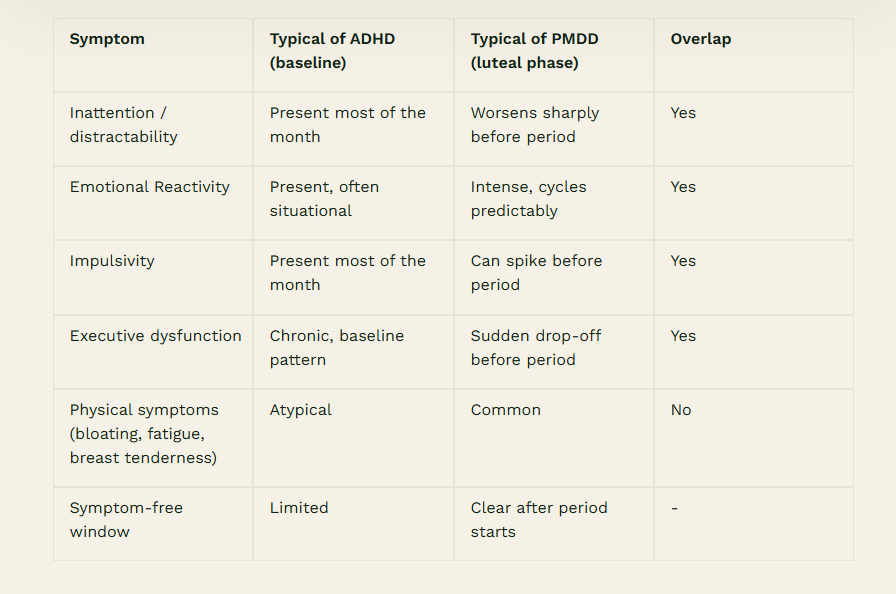
The key signal isn't which symptoms show up, it's whether they have a clear on/off pattern tied to the luteal phase, or whether they're present all month at a lower baseline.
What Should You Do if You Suspect PMDD?
- Track symptoms alongside your cycle, not separately. Use a single tracker for mood, focus, impulsivity, and cycle day. A pattern that repeats month after month is information your provider needs.
- Look specifically at the luteal phase. Note whether symptoms intensify in the one to two weeks before your period and ease shortly after it starts. This timing is the clearest distinguishing feature.
- Bring the pattern, not just the symptoms, to a provider. "I have trouble focusing" gets a different (and often incomplete) answer than "I have trouble focusing all month, but it becomes unmanageable two weeks before my period."
How July Health Approaches the ADHD–PMDD Overlap
If this article describes your own experience, that's not a coincidence, and it's not something you have to keep managing alone or explaining away. At July Health, we see you as a whole person and look at your symptoms as part of the bigger picture.
We understand your lived experience. We know that along with the PMDD diagnosis, comes a history of being told “it’s just bad PMS” and “everyone feels down sometimes.” At July Health, our providers know what it feels like to be minimized so we pride ourselves on our anti-dismissal model. This means that your story, your symptoms and your journey matters.
Our therapists are trained to understand the challenges women with ADHD face, how they can present during the luteal phase as well as the cyclical nature of PMDD. Working with a therapist who can help you build skills for the ups and downs of your cycle as well as process the emotional weight that comes with the diagnosis is a game changer.
If you’re ready to talk to a team that truly listens and knows how to help you navigate your health, book a session with one of our clinicians today.
This article is for informational purposes only and is not a substitute for professional medical advice. Talk to your healthcare provider about testing and treatment options tailored to you.
References:
1. Broughton T, Lambert E, Wertz J, Agnew-Blais J. Increased risk of provisional premenstrual dysphoric disorder (PMDD) among females with attention-deficit hyperactivity disorder (ADHD): cross-sectional survey study. The British Journal of Psychiatry. 2025;226(6):410-417. doi:10.1192/bjp.2025.104
2. Kooij J, Jong M, Agnew-Blais J, et al. Research Advances and Future Directions in Female ADHD: The Lifelong Interplay of Hormonal Fluctuations with Mood, Cognition, and Disease. Frontiers. 2025;6. doi:10.3389/fgwh.2025.1613628
3. Steiner M, Pearlstein T, Cohen LS, et al. Expert Guidelines for the Treatment of Severe PMS, PMDD, and Comorbidities: The Role of SSRIs. Journal of Women’s Health. 2006;15(1):57-69. doi:10.1089/jwh.2006.15.57
4. Hantsoo L, Payne JL. Towards understanding the biology of premenstrual dysphoric disorder: From genes to GABA. Neuroscience & Biobehavioral Reviews. 2023;149:105168. doi:10.1016/j.neubiorev.2023.105168
5. Gupta K, Patel SJ. Prevalence and Management of Premenstrual Dysphoric Disorder (PMDD): Literature Review. rrijm. 2024;9(6):316-321. doi:10.31305/rrijm.2024.v09.n06.038
6. Pataki B, Kiss BL, Juhász I, Kálmán S, Kovács I. Premenstrual dysphoric disorder—an undervalued diagnosis? Preliminary results of a prospective study on Hungarian women. European Psychiatry. 2024;67(S1):S121-S122. doi:10.1192/j.eurpsy.2024.287
7. Islas-Preciado D, Ramos-Lira L, Estrada-Camarena E. Unveiling the burden of premenstrual dysphoric disorder: a narrative review to call for gender perspective and intersectional approaches. Front Psychiatry. 2025;15:1458114. doi:10.3389/fpsyt.2024.1458114
8. Schroll J, Lauritsen M. Premenstrual dysphoric disorder: A controversial new diagnosis. Acta Obstetricia et Gynecologica Scandinavica. 2022;101:482-483. doi:10.1111/aogs.14360
9. Rapkin AJ, O’Brien PMS, Schmidt PJ, eds. The Premenstrual Syndromes: PMS and PMDD. Informa Healthcare Distributed in North and South America by Taylor & Francis; 2007.
10. Lin PC, Long CY, Ko CH, Yen JY. Comorbid Attention Deficit Hyperactivity Disorder in Women with Premenstrual Dysphoric Disorder. Journal of Women’s Health. 2024;33(9):1267-1275. doi:10.1089/jwh.2023.0907
11. Osborn E, Brooks J, O’Brien PMS, Wittkowski A. Suicidality in women with Premenstrual Dysphoric Disorder: a systematic literature review. Arch Womens Ment Health. 2021;24(2):173-184. doi:10.1007/s00737-020-01054-8